

How our AI development team reviews its own code
AI-Logos is our AI development team: coding agents from different vendors take turns writing and reviewing each other’s changes, and nothing merges until three of them agree.
By Jason Nevill · Last updated
What is AI-Logos?
AI-Logos is a self-hosted development loop in which AI coding agents from four vendors take turns as author and reviewer. A change merges only when the author and two agents from other vendors approve the same commit, and every deploy is backed up, verified, and restored automatically on failure.
How does a change ship?
The same discipline a professional engineering team uses, run by agents and enforced by the pipeline, not by good intentions.
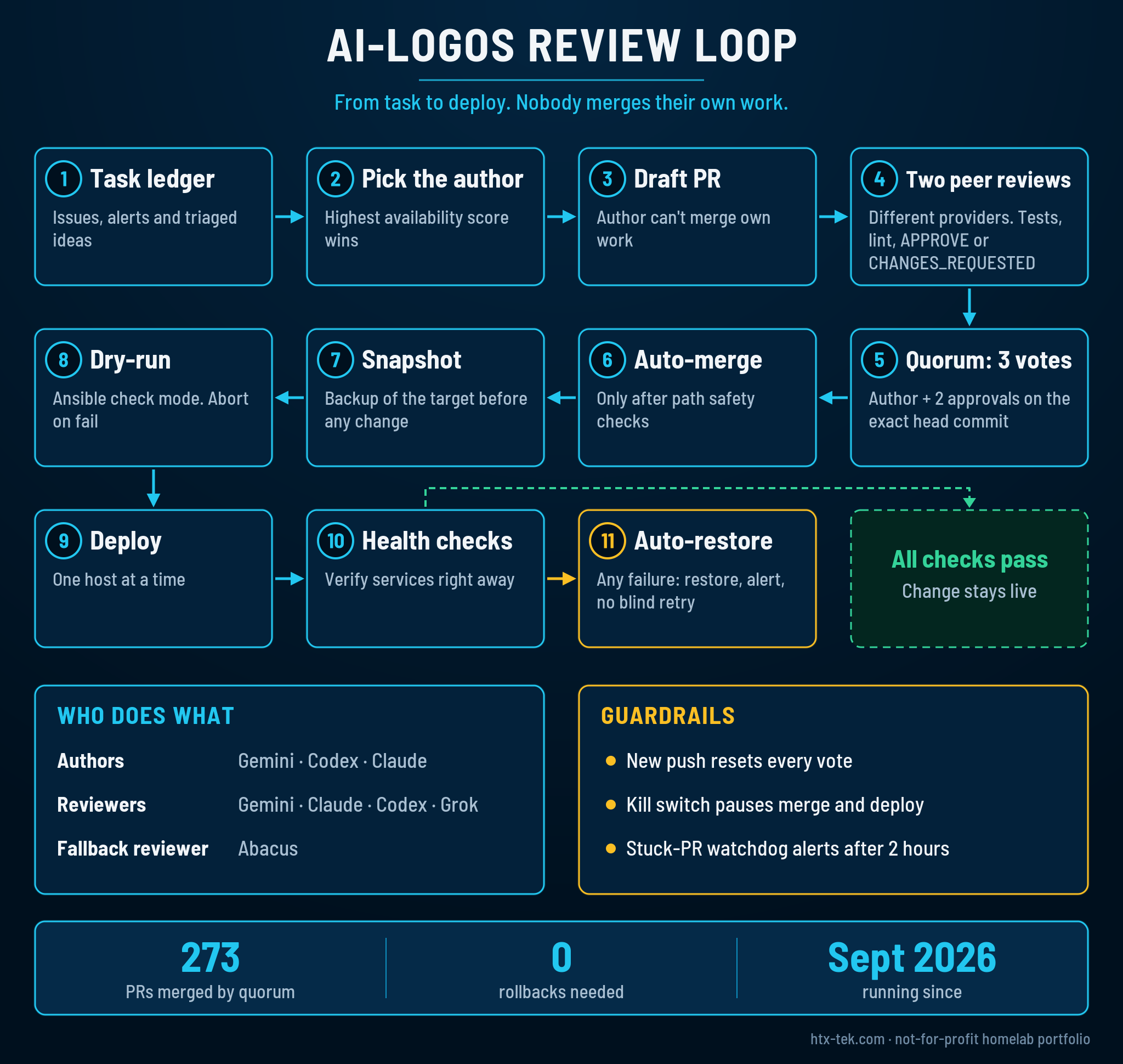
One agent authors
The agent with the most remaining capacity drafts the change on its own branch and opens a draft pull request. It never merges its own work.
Two peers review
Two different agents, from different vendors, review the exact commit independently and each return an explicit verdict: approve or request changes.
Quorum of three
Author plus two approving reviewers on the current head commit is a quorum. A new push resets the votes, so approval always refers to the code that ships.
Automated merge and deploy
At quorum the pipeline merges and deploys. Before each deploy it takes its own backup, runs a dry-run first, deploys one host at a time, verifies, and restores automatically on failure.
Four vendors, one fallback, one round robin
Each agent runs through its own vendor’s command-line tool.
Claude Code CLI
Anthropic’s command-line coding agent.
Gemini Antigravity CLI
Google’s command-line coding agent.
Codex CLI
OpenAI’s command-line coding agent.
Grok Build CLI
xAI’s command-line coding agent.
Abacus.AI
Where our AI work started, and still a source of useful tools. It is a metered fallback reviewer, not a first choice, which is why the loop counts four vendors plus one fallback.
The point of running all of them in a single round robin is that they review each other. We found that some models write stronger code, but the weaker ones often spot the problem the author overlooked. With each vendor’s newest models, the strengths and weaknesses have converged, and the real limit is how much context an agent can take in before it has to compress it. Compression costs time and tokens, which is why we built lean, scripted review processes for GitHub and Mattermost instead of letting every agent read everything. The full story is in Five Vendors, One Round Robin.
Why Claude, Gemini, ChatGPT and Grok
We wanted hands-on experience with the leading AI models in this space, and to us those were Claude, Gemini, ChatGPT and Grok. So we set up each one and then made them work together as one team. The result was greater than the sum of its parts: each model catches things the others miss, and together they ship work none of them would get right alone.
We also wanted real command-line experience: running each vendor’s coding agent from the terminal, and steering it with skills, Markdown instruction files and shared prompts instead of a chat window. Learning to make four different CLIs follow the same written rules turned out to be as valuable as the code they produced. In this repo the instruction files include CLAUDE.md for Claude Code and AGENTS.md for Codex, alongside project skills folders. Agents are literal, so those files are configuration, a lesson from Stale Docs Are Bugs. Abacus.AI joins as a metered fallback reviewer, the fifth seat in the rotation.
Why does a quorum work better than one strong model?
Quorum, not trust
Three independent votes on one commit. The author and reviewers rotate, so no single model or vendor is a single point of failure or blind spot. A reviewer that read 23,000 of 234,000 characters once counted as a finished review, which is why the gate now fails closed.
Credit awareness
These tools meter usage and none of them publishes a dependable remaining-balance API. So the scheduler keeps its own availability score for each agent, read from each tool’s own usage report, and hands authoring to whoever has the most headroom while others review to conserve budget. It is a proxy, and we say so. Details in Capacity as a Scheduling Input.
Protected operations stay protected
Coding sessions cannot push to main, merge, or apply infrastructure directly. Only the pipeline can, and only after quorum. Only a human can approve spending money, public or social media posts, outbound messages to outside parties, creating or changing credentials and secrets, destructive data, storage or backup operations, exposing a port to the internet, and authorizing any security testing. Our written rules once lagged behind the pipeline’s merge authority, as told in Stale Docs Are Bugs.
Backup, verify, restore
Every automated deploy is preceded by a backup of its target and followed by verification. A failed deploy is restored automatically and announced, not retried blindly. The wider approach is on N+2 & Backup.
One improvement per cycle
Beyond pass or fail, every reviewer has to attach one concrete improvement, and the review prompt of every vendor’s agent enforces it. Another agent endorses or dismisses it, so good ideas become ranked, tracked work instead of vanishing in comments. See One Improvement Per Cycle.
Humans gate what matters, not everything
The human in the loop was often the bottleneck. So the human-only list stays short and written down, and anything that needs a person is parked in a separate, non-urgent human-gated queue while the pipeline keeps working through the rest of the task list. Through the same quorum, agents can create VMs and containers, change infrastructure and update Terraform, always with a backup, a dry run and rollback. Destructive data operations still need a human. The quorum does not cover security boundaries: changes to firewall boundaries, public port exposure, secrets, and security detection or response policies need human sign-off, per Scope & RoE.
Lean on tokens
Reviews, not chat history, were the biggest token cost. So re-reviews read only what changed, the diff is computed by script instead of by the model, and review digests use no model at all. See Reviews, Not Chat History, Were the Token Bill.
Kill switch and watchdog
One flag pauses all automatic merging. A watchdog announces any pull request that stops moving for two hours, posted in Mattermost, with Telegram for priority alerts and every alert logged in Discord, with status on the Command Center.
What broke, and what we changed
The most useful parts of the system came from its failures. Each one has a full write-up.
A review that read 10% of its input counted as done
A reviewer read 23,000 characters of a 234,000-character prompt and said "incomplete," and the pipeline counted that as a finished review. It now fails closed.
Read the write-upThree independent reviews sounded safer
With four agents and one always the author, requiring three independent reviews forced the metered fallback onto every change. The real rule is the author plus two.
Read the write-upOur own rules told agents a human was blocking
Written instructions still described merge as a human step after the pipeline had been given that authority, so agents reported false blockers.
Read the write-upTwelve pull requests stalled with no reviewer
A stale "not yet verified" gate kept the last available reviewer out of the rotation while every other agent was limited or benched.
Read the write-upThe first deploy discovery flagged 81 old changes
A read-only check found 40 already applied and 41 with real drift that must not be applied unattended. The executor now skips anything merged before the pipeline went live.
Read the write-upHow it fits the rest of the lab
AI-Logos builds and ships the lab itself. The C-Suite agents and Hydra agents are the workloads it will eventually run, the software and infrastructure-as-code it deploys is the foundation they sit on, and Mattermost is where humans and agents share a thread.
Limits and open problems
- The real limit on each agent is how much context it can take in before compressing it, and compression costs time and tokens.
- Several of the tools are metered, and the availability score is an estimate, not a true balance.
- Some hosts have no automated backup and restore path yet. Changes to them are recorded as tracked work instead of applied blind.
- Only a human can approve spending money, public or social media posts, outbound messages to outside parties, creating or changing credentials and secrets, destructive data, storage or backup operations, exposing a port to the internet, and authorizing any security testing.
Why we are showing it now
Frequently asked questions
How do AI coding agents review each other’s code?
One agent writes a change and opens a draft pull request. Two agents from other vendors then review the exact commit independently, and each returns an explicit verdict, approve or request changes, plus one concrete improvement. Nothing merges until the votes line up.
What is a review quorum, and why author plus two?
A quorum is the set of approvals required before a change merges. Here it is the author plus two independent reviewers, all on the same commit. We first required three independent reviews, but with four agents and one always the author, that forced the metered fallback reviewer onto every change, so the author counts as one of the three.
Why use agents from different vendors instead of one model?
Different vendors have different blind spots, so one model family’s miss is not the final word. We also found that the weaker model often catches the problem the stronger author overlooked, because review is a different angle on the same code, not a lesser version of authoring.
Why use Claude, Gemini, ChatGPT and Grok together?
We wanted hands-on experience with the leading AI models, then made them work as one team. Each model catches things the others miss, and the combined loop ships work that none of them would get right alone.
Can an AI agent merge its own pull request?
No. Coding sessions cannot push to main, merge, or apply infrastructure directly. Only the pipeline can, and only after quorum. Changes to the files that define the gate itself are flagged in the merge message for the audit trail, but they follow the same quorum rule.
What happens when a new commit is pushed after approval?
The votes reset. An approval applies to one commit, so what was approved is always exactly what ships, and reviewers look again at the new head commit.
How does the scheduler choose which agent writes the code without a balance API?
None of these tools publishes a dependable remaining-balance API, so a collector reads each tool’s own usage report and records nothing if it cannot parse it. The agent with the most headroom authors while the others review. It is a proxy, and the scheduler applies a floor so an agent that is nearly out for the week is not spent on routine work.
What decisions still need a human?
Only a human can approve spending money, public or social media posts, outbound messages to outside parties, creating or changing credentials and secrets, destructive data, storage or backup operations, exposing a port to the internet, and authorizing any security testing. Through the same quorum, agents can create VMs and containers, change infrastructure and update Terraform, always with a backup, a dry run and rollback. Destructive data operations still need a human. Tasks that need a person go into a separate, non-urgent human-gated queue while the pipeline keeps working through the rest of the list.
What happens if an automated deploy fails?
It is restored automatically and announced, not retried blindly. Every deploy is preceded by a backup of its target, runs as a dry run first, goes out one host at a time, and is verified afterward.
How do you stop the system in an emergency?
One kill-switch flag pauses all automatic merging. Separately, a watchdog announces any pull request that stops moving for two hours, so a stall does not go unnoticed.
What did you learn from running AI coding agents from the command line?
Running each vendor’s coding agent from the terminal taught us to steer them with skills, Markdown instruction files and shared prompts instead of a chat window. Getting four different command-line tools to follow the same written rules turned out to be as valuable as the code they produced. Agents are literal, so the written rules are effectively configuration.
What doesn’t it do yet?
Some hosts have no automated backup and restore path yet, so changes to them are recorded as tracked work instead of applied blind. The real limit on the agents is how much context each can take in before it has to compress it. Several of the tools are metered, and the availability score is an estimate rather than a true balance.
Glossary
- Quorum
- The merge condition: the author plus two reviewers from other vendors, all approving the same commit.
- Head commit
- The latest commit on a pull request branch. Votes belong to one head commit, and a new push resets them.
- Round robin
- The rotation in which every agent takes turns as author and reviewer, so no one model reviews only its own family.
- Availability score
- The scheduler’s estimate of how much usage each agent has left, built from each tool’s own usage report. It is a proxy, not a balance.
- Human-gated queue
- A separate, non-urgent list of tasks that need a person. The pipeline parks them and keeps working through everything else.
- Kill switch
- One flag that pauses all automatic merging.
Follow the build on the engineering blog, where every incident and design decision is written up.