

Cut one head off, it grows back — carefully.
Self-healing infrastructure: detect a failure, propose a fix, wait for a human to approve it.
By Jason Nevill · Last updated November 19, 2026
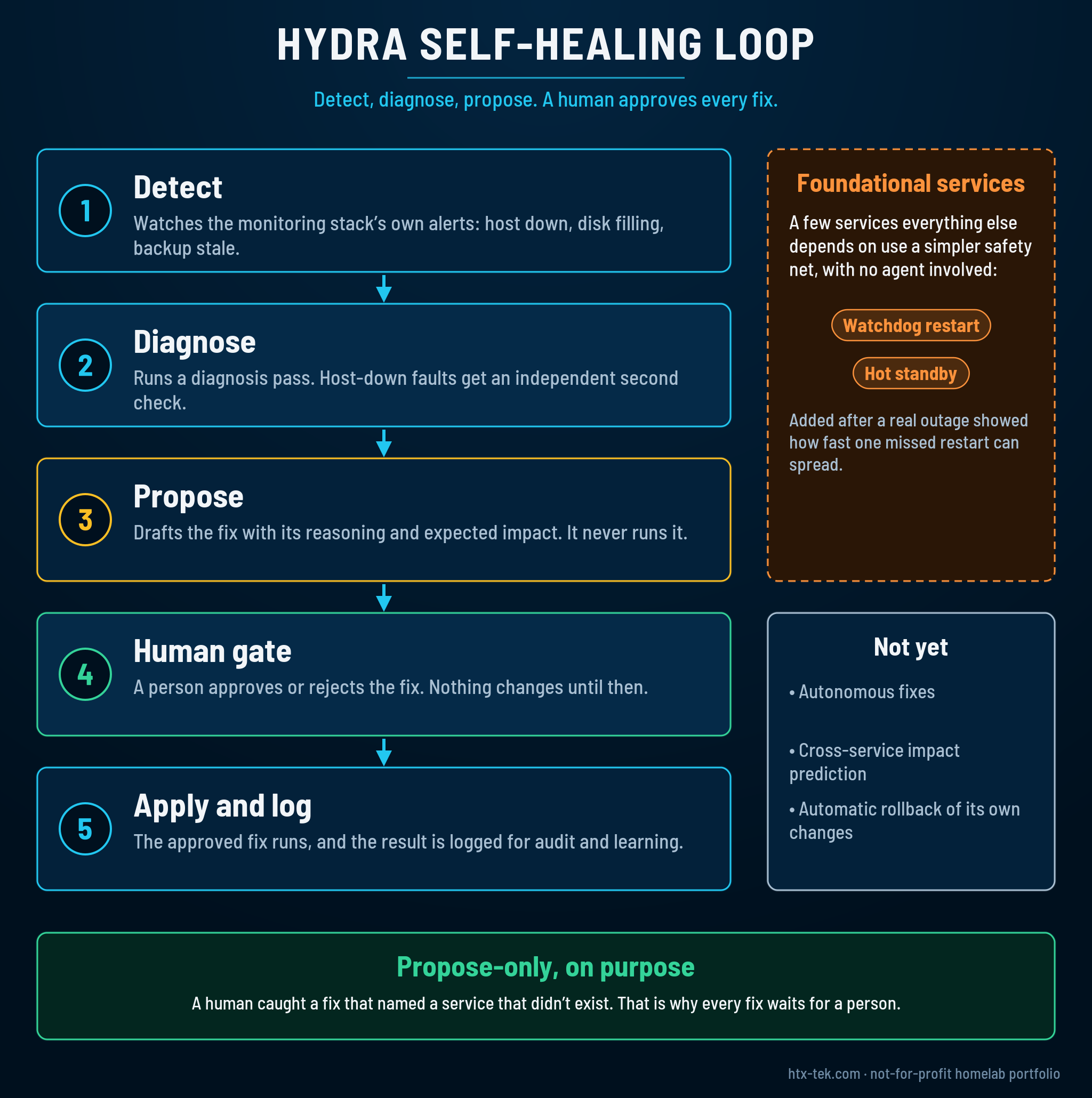
Hydra is the self-healing layer of our homelab. It watches the alerts our monitoring already raises, diagnoses each new fault, and drafts a fix with its reasoning and expected impact. It never applies that fix on its own: a person approves or rejects every proposal. A few foundational services have a simple watchdog restart instead.
How does Hydra work?
Two phases. One rule: Hydra never applies a fix it proposed until a person approves it.
A few foundational services have a simple watchdog restart, and infrastructure, VM, container and Terraform changes go through the AI-Logos peer quorum. Through the same quorum, agents can create VMs and containers, change infrastructure and update Terraform, always with a backup, a dry run and rollback. Destructive data operations still need a human.
Detected
Monitoring raises a failure
Proposed fix
A drafted fix, never run
Awaiting approval
A person decides
Healed
Approved, applied and checked


Phase 1 — Detection
Hydra watches the monitoring stack's own alert rules: host down, disk almost full, backup stale. Security alerts and how people triage them are covered on the Blue Team page. A newly-firing alert gets a real diagnosis pass; when the alert clears, Hydra marks it resolved. Nothing new to watch is invented — it's a real consumer sitting on top of detection that already existed.
This is deliberately scoped, not a marketing claim of doing everything at once: today it's host/service-level metric alerts, not application-log or security-event correlation. A host-down fault also gets an independent second check — CISO cross-verifies the same real metrics (a defensive, read-only check; it changes nothing) before Hydra calls a fault resolved, so a false "all clear" doesn't slip through on Hydra's own say-so.
Phase 2 — Propose-Only Remediation
When Hydra detects a fixable issue, it drafts a remediation plan. Restart a service? It writes the exact command. Rotate a certificate? It prepares the renewal. Failover to a backup? It stages the DNS change.
But it never executes. Every proposed fix sits in a queue with full reasoning, context, and predicted impact until a human reviews and approves it. This is not a speed optimization — it's a deliberate trust boundary.
Why propose-only, not autonomous?
Because autonomous remediation at this stage is reckless. Our infrastructure is complex enough that a "fix" in one layer can cascade into a failure in another. An agent that restarts a database container might kill an in-progress migration. An agent that rotates a cert might break a dependent service that hasn't reloaded yet.
We'll earn autonomous remediation. But earning it means proving, over hundreds of proposals, that Hydra's reasoning is sound, its commands are safe, and its blast radius is predictable. We're not there yet, and we say so.
Any autonomy Hydra earns will be limited to low-risk, reversible operational recovery, such as restarting a non-critical service. It will never override the human-only gates on Scope & RoE: credentials and secrets, firewall and port exposure, destructive data or backup operations, and security-event response.
What has Hydra caught?
- A silently failed backup target: for three days backups were not landing anywhere restorable before the anomaly was flagged.
- A certificate 72 hours from expiry on an internal service that wasn't in the renewal rotation.
- A container memory leak that was 6 hours from OOM-killing the database container on the same host.
- A DNS record pointing to a decommissioned IP after a host migration.
A real finding worth being honest about
Hydra once proposed a remediation that included a hallucinated command — a systemctl restart for a service name that didn't exist. The detection was correct. The reasoning was correct. The fix was fabricated.
This is exactly why propose-only matters. If this had been autonomous, it would have failed silently (best case) or broken something else (worst case). Because a human reviewed it, the bad command was caught, the real fix was written, and Hydra's prompt was updated to cross-reference service names against the actual service registry.
A real outage, not a drill
Our DHCP server went down during a host reboot. Nothing dramatic — a misconfigured restart policy meant the container didn't come back up. But DHCP is foundational: within minutes, lease renewals started failing, devices started dropping off the network, and monitoring went blind because the monitoring agents couldn't reach their endpoints.
The cascade was fast. One service, one missed restart policy, and the whole network degraded within 15 minutes.
Fixed two ways
Watchdog
A lightweight watchdog now monitors the DHCP container specifically. If it goes down, the watchdog restarts it within seconds — no agent involvement, no approval gate. Some things are too foundational for propose-only.
Hot Standby
A second DHCP instance runs on a different host in hot-standby mode. If the primary fails and the watchdog fails, the standby takes over leases automatically. Belt and suspenders.
What can't Hydra do yet?
Proven
- Detection of host and service alerts from our monitoring stack
- Propose-only remediation with human gate
- Real findings caught before they became outages
- DHCP failover (watchdog + hot standby)
Not Yet
- Autonomous remediation (earning trust first; if earned, limited to low-risk, reversible recovery, never the human-only gates)
- Cross-service impact prediction
- Automatic rollback of Hydra's own changes
- Full coverage of every edge-case failure mode
- Log or security-event correlation (metric alerts only today)
- Working when the monitoring stack itself is down
What is the next step: a short human window?
A design we wrote up in automated remediation with a 180-second human window would let the system back up, fix, verify and roll back on its own if nobody answers within a short window. It ships switched off, and human-only actions are excluded from it. Today, no reply means no action.
How does Hydra fit with the rest of the lab?
A person approves every fix from the same human-only list our C-Suite agents follow; code changes go through the AI-Logos author-plus-two quorum. Backups are covered on N+2 & Backup, with the story in recovering from silent VM backup failures. The DHCP outage is written up in Kea DHCP failover and the phantom clients. Proposals show up as described on Communications, and fleet status is on the Command Center.
Frequently asked questions
- What is Hydra?
- Hydra is the self-healing layer of our homelab. It watches the alerts our monitoring already raises, diagnoses each new fault and drafts a fix with its reasoning and expected impact. A person approves or rejects every proposal.
- Does Hydra fix problems automatically?
- No. It drafts the fix and a person approves it. The exceptions are a few foundational services with a simple watchdog restart and a hot standby, with no agent involved.
- What does Hydra watch?
- Host and service alerts from the existing monitoring stack, such as a host going down, a disk filling up or a backup going stale. It doesn’t yet correlate application logs or security events.
- How does Hydra avoid false “all clear” messages?
- A host-down fault gets an independent second check against the same real metrics before it’s marked resolved. The checker is the CISO agent, in its defensive role only.
- What happened when Hydra got a fix wrong?
- It proposed a restart for a service that didn’t exist. A person caught it, wrote the real fix, and Hydra now checks service names against the real service list.
- Which actions always need a human?
- Only a human can approve spending money, public or social media posts, outbound messages to outside parties, creating or changing credentials and secrets, destructive data, storage or backup operations, exposing a port to the internet, and authorizing any security testing. Hydra is stricter than that list: every fix it proposes waits for a person.
- What happens if nobody answers a Hydra proposal?
- Nothing happens. The proposal waits until a person approves, rejects or changes it. A design with a short human window exists but ships switched off, and human-only actions are excluded from it.
- How is Hydra different from the AI-Logos pipeline?
- AI-Logos handles code and configuration changes through an author-plus-two quorum with a backup, a dry run and automatic restore. Hydra handles live faults and proposes fixes for a person to approve.
- What can’t Hydra do yet?
- It can’t fix things autonomously, predict the impact of a fix across services, or roll back its own changes automatically. It also depends on the monitoring stack being up, and it covers metric alerts rather than logs or security events.
Glossary
- Self-healing:
- Detecting a failure and drafting or applying a fix without a person doing the diagnosis.
- Propose-only:
- The system may describe a fix and ask for approval, but may not run it.
- Human gate:
- A point where a person must approve before anything changes.
- Watchdog restart:
- A small, fixed rule that restarts one foundational service when it stops, with no agent involved.
- Hot standby:
- A second copy of a service that is already running and takes over if the first fails.
- Blast radius:
- How much else could break if a fix goes wrong.
- Second check:
- An independent comparison against the same real metrics before a fault is marked resolved.
Who built this: Jason Nevill.