

Security we build for ourselves.
How we defend our own lab, and how we check that the defenses work.
By Jason Nevill · Last updated November 19, 2026
The homelab has seven layers of defense: DNS filtering, a default-deny firewall, segmented trust zones, zero-trust remote access, central logging and monitoring, N+2 backups and separate secrets management. Two are still being finished: the isolated test lab's firewall rules are being tightened, and the encrypted offline and cloud backup copies are in progress. Claude helps triage, write detections and draft fixes, and no AI does offensive testing or exploitation.
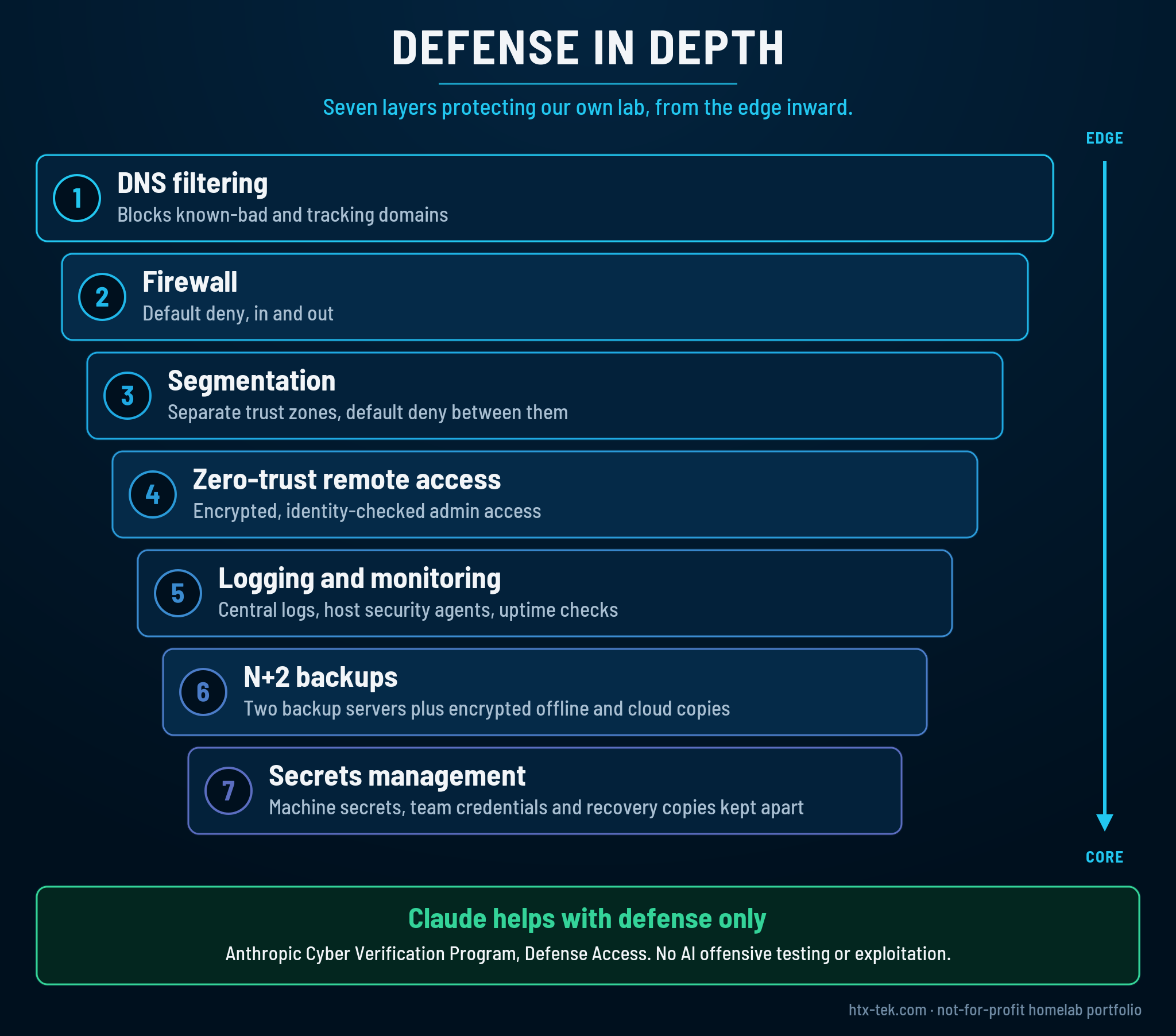
How is the lab defended?
Seven layers, each explained where it is built.
- DNS filtering. Lookups for malicious, tracking and unwanted domains are answered with a dead end, on redundant resolvers. clustered DNS
- A default-deny firewall. Traffic is blocked unless a rule explicitly allows it, at the edge and between zones. isolated subnets and egress proxying
- Segmented trust zones. Core infrastructure, management, agent workloads and untrusted devices are kept apart with firewall rules between zones; the isolated test lab's rules are still being tightened. segmenting a flat network
- Zero-trust remote access. Access is granted per identity under tag-based, default-deny rules, with no open admin ports. zero trust before going public
- Central logging and monitoring. A SIEM, host security agents, network intrusion sensors and a community blocklist feed alerts to chat. a security stack in a night · where alerts land
- N+2 backups. Two independent backup servers, with encrypted offline and cloud copies in progress. N+2 & Backup
- Separate secrets management. Machine secrets, team credentials and offline copies are kept apart, behind a private certificate authority. secrets recovery · private PKI
How we use these layers day to day is on the Blue Team page: how we defend the lab day to day. Alerts reach us as described on Communications, Hydra proposes fixes, and fixes are written as code through our AI Development Team. The separate test laptop has its own five safeguards (Methodology).
Scope and authorization come first
Nothing is tested without a written scope, every target is infrastructure we own, and every active step is run by a person after a human approves it. Our AI use is limited to Anthropic’s Cyber Verification Program, Defense Access tier: AI helps triage findings, map them to MITRE ATT&CK, tune detections, analyze logs and draft fixes. People run every active check, and no AI does offensive testing or exploitation. The full rules are on the Scope & RoE page.
How does AI help, and where does it stop?
| AI helps with | AI never does |
|---|---|
| Triaging scan results and attack-surface findings | Plan attacks or choose targets |
| Mapping findings to MITRE ATT&CK | Write attack or exploit code |
| Writing, reviewing and tuning detection rules | Scan, probe or verify by testing a live system |
| Analyzing logs, event streams and alerts | Launch any test or simulation |
| Drafting fixes as code and defensive documentation | Approve anything on the human-only list |
Only a human can approve spending money, public or social media posts, outbound messages to outside parties, creating or changing credentials and secrets, destructive data, storage or backup operations, exposing a port to the internet, and authorizing any security testing.
How do we check that the defenses work?
Automation is fast at the boring parts. People hold the keys to anything active.
Passive look
Scripted, our own footprint
Two-agent triage
AI, defensive
Gate 1
Human approval
Hands-on check
Run by a human
Gate 2
Human approval
Fix, detect, re-test
As code, reviewed
The full 15-step workflow is on Methodology. Purple teaming (running a technique, checking what the defenses saw, fixing the gap and running it again) is designed and planned, and the first exercise has not been run yet; see Purple Team. More: Assessments, OSINT, Red Team and the training visualizer.
Frequently asked questions
- How is the HTX-TEK homelab defended?
- Seven layers: DNS filtering, a default-deny firewall, segmented trust zones, zero-trust remote access, central logging and monitoring, N+2 backups and separate secrets management. Two are still being finished: the isolated test lab's firewall rules are being tightened, and the encrypted offline and cloud backup copies are in progress.
- Does HTX-TEK offer security testing or services?
- No. Everything here is about our own lab, shared to show the engineering. We don’t test anyone else’s systems.
- What does AI do in your security work?
- AI helps triage findings, map them to MITRE ATT&CK, tune detections, analyze logs and draft fixes. People run every active check, and no AI does offensive testing or exploitation.
- Does AI ever attack or exploit anything?
- No. People run every active check, by hand, after a human approval gate, and only against our own lab.
- Which actions always need a human?
- Spending money, public posts, outbound messages, credential changes, destructive data or backup operations, exposing a port, and authorizing any security testing. The full list is on Scope & RoE.
- How do you know the defenses work?
- Every fix is re-tested so the new detection has to fire, and we plan purple-team rounds that compare what was done with what our monitoring saw. The first purple-team round has not run yet.
- Is any of this kept apart from work?
- Yes. The test laptop is kept completely apart from any work accounts, networks, VPNs or hardware.
Glossary
- Defense in depth:
- Stacking several independent protections so that one failing never exposes everything.
- Trust zone:
- A group of devices with the same level of trust, separated from other groups by firewall rules.
- Default deny:
- A firewall posture where traffic is blocked unless a rule explicitly allows it.
- Zero trust:
- Access that is granted per identity and per request, never because a device is already on the network.
- SIEM:
- A central system that collects logs and events from many machines and raises alerts on suspicious patterns.
- Detection rule:
- A written condition that turns matching log events into an alert.
- MITRE ATT&CK:
- A public catalog of attacker tactics and techniques, used here to label what a detection should catch.
- Defense Access:
- The defense-only tier of Anthropic’s Cyber Verification Program, which limits AI use to defensive work.
Who built this: Jason Nevill.