

One request in. A real org chart behind it.
A flat AI organization: CEO, CISO, CMO, COO and CTO, each gated by real approval chains.
By Jason Nevill · Last updated November 19, 2026
Every request goes to Vik, the CEO agent, who screens and routes it to the CISO, CMO, COO or CTO agent. A CAIO audits past decisions from outside the chain. Stop-Gap watches for errors, and SPS-Agent checks claims against real system state. Agents draft on their own, infrastructure changes need peer quorum, and spending, posting and credentials need a human.
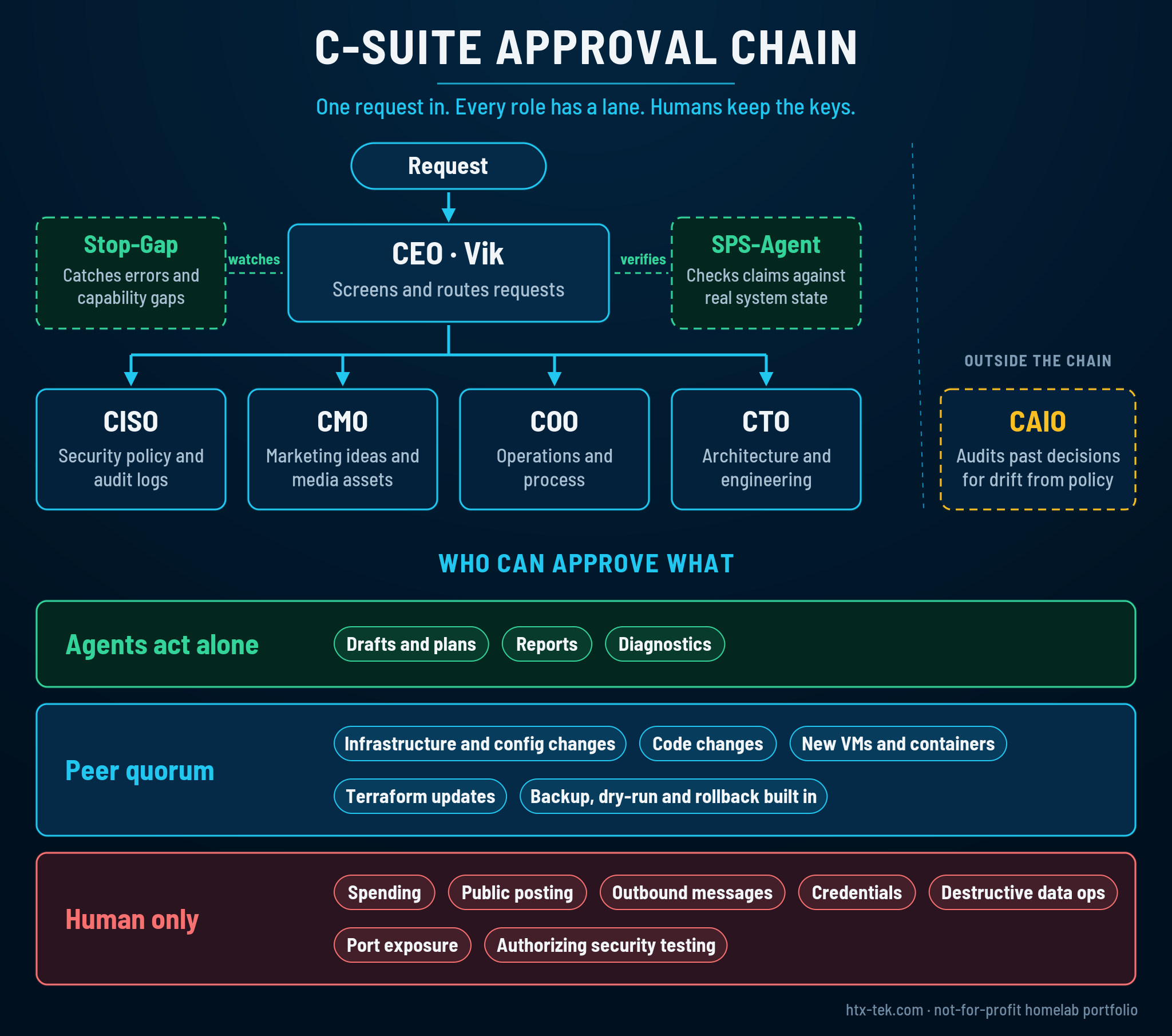
The Org Chart
Flat by design. Every agent reports directly to the CEO. No middle management, no ambiguity.
What does each agent do?
Roles in the flat chain, and where each one stops.
Vik (CEO)
Screens and routes every request and manages the roster. Never approves spending.
CISO
Security policy, vulnerability triage, compliance posture, audit trail. Defensive duties only: triage, ATT&CK mapping, detection tuning and compliance review, never offensive planning or execution.
CMO
Drafts marketing content, brand images and video. Nothing is posted publicly without a human approving it.
COO
Operations, process enforcement, resource allocation and scheduling, inside the same approval gates.
CTO
Architecture and tech-stack proposals and infrastructure planning. Changes go through the peer quorum or a human gate.
Action Gating
What "gated" actually means — three tiers of autonomy.
Drafting and read-only diagnostics
Full autonomy
Agents draft content, code, and reports and run read-only diagnostics without approval.
Human only
Propose-only, human gate
Only a human can approve spending money, public or social media posts, outbound messages to outside parties, creating or changing credentials and secrets, destructive data, storage or backup operations, exposing a port to the internet, and authorizing any security testing.
Standard infrastructure as code (peer quorum)
Peer quorum, standard changes only
Code changes, creating VMs and containers, and Terraform updates go through the AI-Logos author-plus-two quorum on the same commit, with a backup first, a dry run and automatic rollback. Security controls, firewall rules, credentials, port exposure, active security testing and incident containment are never agent-to-agent decisions: they always need explicit human approval.
The full human-approval rules are on Scope & RoE; the quorum is described on AI-Logos.
The Chain (Flattened Org)
Every agent reports directly to the CEO agent. There's no VP layer, no director layer, no team leads. This is deliberate: fewer handoffs means fewer places for instructions to get distorted, fewer approval bottlenecks, and a single audit trail for every decision.
The CAIO (Chief AI Officer) sits outside the chain, drawn dashed above: it doesn't approve or block in real time, but it audits decisions after the fact and flags drift from policy.
A finding we're not hiding
On September 4, 2026, during a live run, I asked Vik to start a new project. The COO agent returned a plain to-do list: develop the system, design three landing pages, set up guest access. Vik’s summary back to me turned every item on that list into past tense: “Three separate landing pages have been designed… the necessary website infrastructure has been developed.” None of it existed. The plan had become a progress report.
We caught it the same night by checking the claims against what was actually on disk. The fix was a new rule in the instructions Vik uses to write its summaries: a task breakdown is always a pending plan, never finished work, however confident it sounds. An agent that writes fluently can also report fluently on work nobody did. That is why claims get checked against real state, and why publishing still needs a human.
Why a second, independent checker exists
The SPS-Agent (Second-Pass Safety) works like the tie-breaking witness in a server cluster: it does none of the work and has no say over what work happens. On a fixed schedule it reads the agents’ own activity records and checks what they claim against the real state of the systems, looking hardest for claims that something is done when it isn’t.
It sits outside the chain of command on purpose. If the agents could decide when it runs, they could skip it on exactly the runs it would fail. Before it was switched on, we tested it, found it raising too many false alarms, and tuned it over three rounds until its alerts could be trusted.
Where the agents report in
Mattermost
The locally run OpSec and dev hub, where humans and agents share threads.
Telegram
Priority alerts.
Discord
A log of every alert.
SMS
Limited use.
Voice kiosk
Push-to-talk.
A second roster: engineering agents
Below the C-Suite, a roster of specialized engineering agents handles the actual work: DevOps, Backend, Frontend, QA, and DB-Admin. Each takes tasks from the CTO and COO, executes within its scope, and reports results back.
DevOps
Backend
Frontend
QA
DB-Admin
How a human actually approves something
Every gated action produces a proposal: what the agent wants to do, why, what it expects to happen, and what it needs permission for. Approval requests arrive in Mattermost, with Telegram for priority items.
The human responds with approve, reject, or modify. If nobody answers, the action does not execute: silence is not consent. No reply means no action. Every approval and rejection is logged, timestamped, and tied to the original proposal for audit.
How do mistakes get caught?
The CAIO, after the fact. It audits decisions from outside the chain and flags drift from policy.
Stop-Gap, in the moment. It watches the C-Suite roles for errors and capability gaps and proposes a backup path, which a person approves.
The SPS-Agent, against reality. It checks what agents claim against the real state of the systems, as in the September 4, 2026 finding above.
What can’t the C-Suite do yet?
- The CAIO can’t stop anything in real time.
- The SPS-Agent checks on a fixed cadence, so a false claim can live until its next pass.
- Agents can still write fluent, wrong summaries.
- Several roles are still partly manual.
Where are we headed?
The end goal is a C-Suite that runs on its own. We’re not there, and we won’t pretend to be. Every kind of action stays human-gated until it has proven safe, and only then moves to peer quorum. Creating VMs and containers, infrastructure changes and Terraform updates have made that move. Spending, public posts, outbound messages, credentials, destructive data operations, port exposure and authorizing any security testing still need a person, and silence never counts as a yes.
How does it fit the rest of the lab?
Code and infrastructure changes use the same author-plus-two quorum as the AI-Logos dev team. Hydra, our self-healing layer, proposes fixes the same way. Approvals and alerts arrive through the channels on Communications, every change takes a backup first (see N+2 & Backup), and the CISO agent’s work is defensive only (see Blue Team). The reasoning behind the human-only list is in the human in the loop was the bottleneck and a human-gated queue.
Frequently asked questions
- What is an AI C-suite?
- In this lab it’s a set of AI agents organized like company executives, each with one lane (security, marketing, operations, technology), all reporting to one CEO agent. It’s how our own homelab organizes its agents, not a product.
- Who does the CEO agent report to?
- To the humans who run the lab. Vik screens and routes every request and keeps the audit trail, but it can’t approve spending or anything else on the human-only list. Those wait for a person.
- Which actions always need a human?
- Only a human can approve spending money, public or social media posts, outbound messages to outside parties, creating or changing credentials and secrets, destructive data, storage or backup operations, exposing a port to the internet, and authorizing any security testing.
- What can the agents do without approval?
- Draft plans, code, content and reports, and run read-only diagnostics. Nothing they draft goes live without review.
- What needs peer review instead of a human?
- Infrastructure, configuration and code changes, creating VMs and containers, and Terraform updates. They need the author plus two independent reviewers on the same commit, with a backup first, a dry run and automatic rollback. Destructive data operations still need a human.
- What does the CAIO do if it isn’t in the chain?
- It audits decisions after the fact and flags drift from policy. It can’t approve or block anything in real time, which keeps it independent.
- How do you catch an agent that claims work it didn’t do?
- The SPS-Agent checks agents’ claims against the real state of the systems. The September 4, 2026 finding on this page is the example: a to-do list was reported back as finished work, and checking against what was on disk caught it the same night.
- What happens if nobody answers an approval request?
- Nothing happens. A human-gated action never runs on silence; it waits until a person approves, rejects or changes it.
- Will the C-Suite ever run on its own?
- That’s the goal, but not yet. Each kind of action stays human-gated until it has proven safe, and moves to peer quorum only after that, the way VM, container and Terraform changes did.
- What can’t the C-Suite do yet?
- The CAIO can’t stop anything in real time, the SPS-Agent checks on a fixed cadence so a false claim can live until its next pass, and agents can still write fluent, wrong summaries. Several roles are still partly manual.
Glossary
- CEO agent:
- Vik, the agent that screens and routes every request to the right specialist and keeps the audit trail. It never approves spending.
- CAIO:
- The Chief AI Officer agent, which audits decisions after the fact from outside the chain.
- Stop-Gap:
- The escalation agent that watches the C-Suite roles for errors and capability gaps.
- N+1 backup:
- A second agent or path that can take over a role if the first one fails.
- SPS-Agent (Second-Pass Safety):
- An independent checker that compares agents’ claims with the real state of the systems.
- Propose-only:
- An agent may describe an action and ask for approval, but may not carry it out.
- Peer quorum:
- The author plus two independent reviewers approving the same commit, with a backup, a dry run and automatic rollback.
- Human-only action:
- An action that only a person can approve, such as spending money or exposing a port.
- Audit trail:
- A timestamped record of every proposal, approval and rejection.
Who built this: Jason Nevill. Follow along on LinkedIn and GitHub.