
What runs the build.
Proxmox nodes, GPU passthrough, backup targets, and the fleet of small machines that keep everything alive.
By Jason Nevill · Last updated November 23, 2026
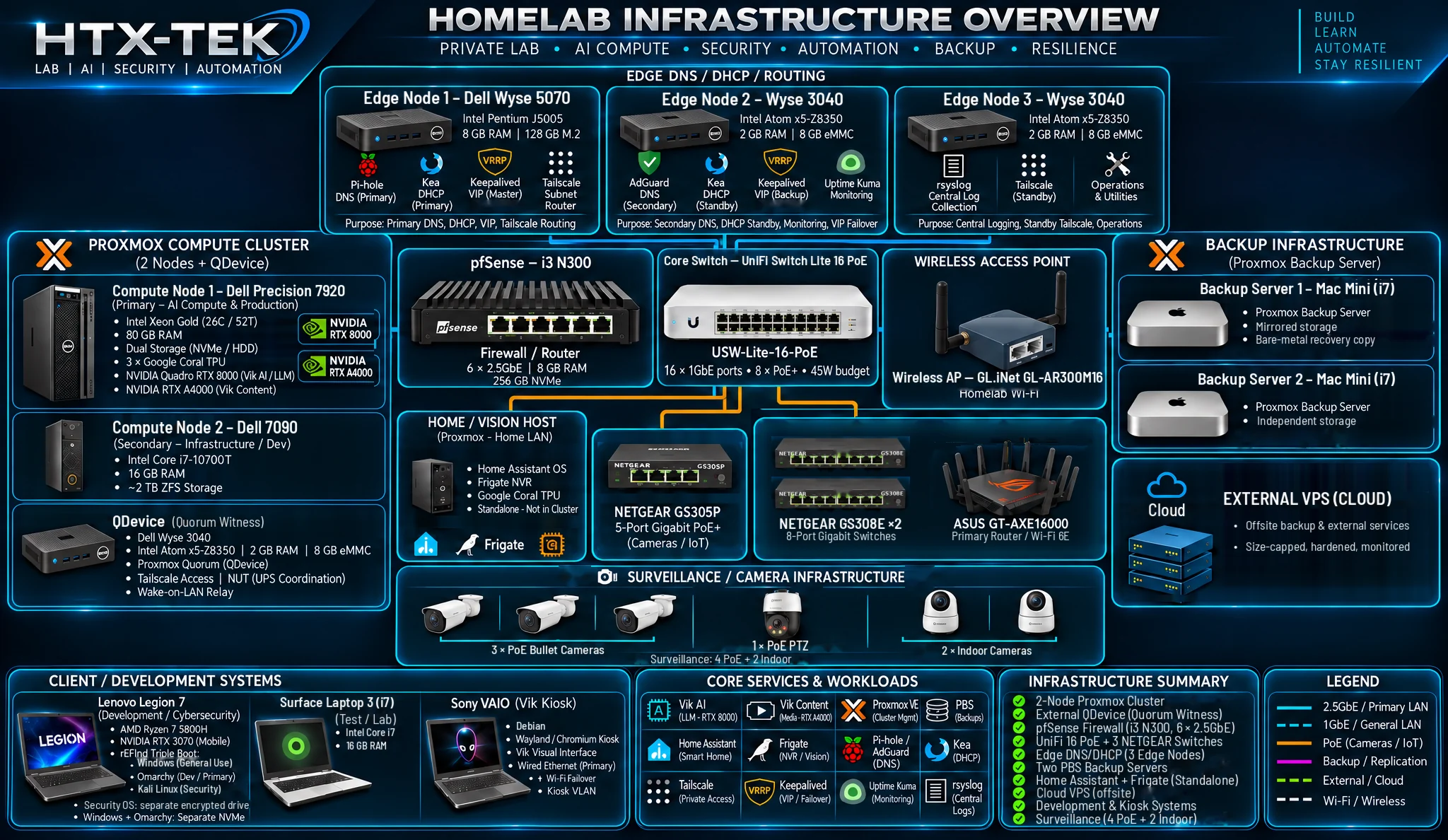
Our homelab runs on a two-node Proxmox cluster with a quorum device, two professional GPUs passed through for local AI models, three small edge nodes for DNS and DHCP, two independent backup servers, and dual UPS units on separate circuits that shut guests down in order. A hardened cloud VPS is the public front door.
What hardware runs the lab?
Every machine has a job. Nothing is idle, nothing is guessed.
Primary Proxmox Node
Main hypervisor — runs production VMs, containers, GPU passthrough for LLM inference.
Secondary Proxmox Node
Failover hypervisor — mirrors critical workloads, handles overflow during heavy inference jobs.
GPU Passthrough Rig
Dedicated GPU compute — passed through to LLM containers for local model hosting.
Primary Backup Server
Proxmox Backup Server — receives its own backup job directly from all nodes.
Secondary Backup Server
A second, fully independent Proxmox Backup Server — its own independent job direct from every node, different hardware, different failure domain. Not a sync from the primary.
Network & Edge Fleet
Managed switches, access points, Raspberry Pis, micro PCs — DNS, monitoring, edge services.
Workstation
Development and administration — direct console access to all infrastructure.
What's New
- GPU passthrough stable and running LLM inference in production.
- Second Proxmox node fully commissioned for failover.
- Two independent backup servers in service, the primary rebuilt after a storage-corruption incident.
- Edge fleet managing DNS and monitoring endpoints.
What's still missing?
- Evaluating a third node for dedicated database workloads.
- Offsite backup tiers (encrypted drives and a cloud copy) — in progress.
Which AI models run locally?
As of November 23, 2026, a local Ollama server with passed-through GPUs hosts four open models. The two small ones handle lightweight tasks. The two large ones, on the 48 GB Quadro RTX 8000, back the cyber-analysis models on the Red Team page. General reasoning and coding work in the lab still uses hosted models.
| Model | Parameters | Size on disk | Runtime |
|---|---|---|---|
| Hermes 3 | 3.2B | 2.0 GB | Ollama, GPU passthrough |
| Qwen 3.5 | 4.7B | 3.4 GB | Ollama, GPU passthrough |
| Hermes 3 | 70B | 39 GB | Ollama, GPU passthrough |
| Qwen 2.5 Coder | 32B | 19 GB | Ollama, GPU passthrough |
Why publish a homelab's hardware?
Hardware decisions are the ones that cost real money and real time. We document ours — what we chose, why, what failed, and what we'd do differently — so you can see the difference between a marketing spec sheet and a production fleet.
The upgrade path
Each step was done live, verified, and written up.
Foundation: clustered Proxmox replaces Unraid
Rebuilt on an enterprise hypervisor cluster with mirrored ZFS storage and unprivileged containers.
Dual-circuit power with automated shutdown
Two UPS units on independent circuits with a distributed NUT setup that shuts guests down in order before power is cut.
Professional GPU compute added
A Quadro RTX 8000 and an RTX A4000 installed and passed through to the AI workloads, including a passthrough bug that silently targeted the wrong card, found and fixed.
Backup tier rebuilt
The primary backup datastore was rebuilt after storage corruption and re-onboarded, and a broken backup job was found and repaired in the same pass.
What has failed?
- August 22, 2026, GPU passthrough. A passthrough mapping silently pointed at a different card, found by verifying rather than assuming. Write-up.
- October 17, 2026, network card stalls. Under heavy virtualization load a Gigabit NIC silently locked up while the kernel stayed alive. Write-up.
- September 6, 2026, backup storage corruption. A mirrored backup pool returned I/O errors with clean drives, and the first fix did not work. Write-up; the rebuild is on N+2 & Backup.
More: leaving Unraid, dual-UPS power automation, enterprise Wi-Fi with a 10G uplink and wake-on-LAN across routed subnets. What runs on this hardware is on Software & IaC, the cloud edge is VPS & Self-Hosting, and the GPU workloads power AI-Logos.
Frequently asked questions
- What hardware runs the HTX-TEK homelab?
- A two-node Proxmox cluster with a quorum device, two professional GPUs for local AI, three small edge nodes for DNS and DHCP, two independent backup servers, managed switches and a firewall, and dual UPS units on separate circuits. A hardened cloud VPS is the public front door.
- Why a two-node cluster with a quorum device?
- With only two nodes, each one could wrongly believe the other is gone and both start the same workloads. A small third vote, the quorum device, breaks the tie so the cluster fails over cleanly and never splits.
- Which GPUs run the local AI models, and how?
- A Quadro RTX 8000 and an RTX A4000, passed through to the AI workloads. Installing them also turned up a passthrough mapping that silently pointed at a different card, which is written up in the GPU post.
- Which AI models run locally?
- As of November 23, 2026, four open models run on a local Ollama server with GPU passthrough: Hermes 3 (3.2B), Qwen 3.5 (4.7B), Hermes 3 (70B), Qwen 2.5 Coder (32B). The two small ones handle lightweight tasks. The two large ones, on the 48 GB Quadro RTX 8000, back three cyber-analysis models described on the Cyber pages. General reasoning and coding work in the lab still uses hosted models.
- What happens when the power goes out?
- Two UPS units on independent circuits signal the hosts, and guests shut down in a set order before power is cut, starting with the write-heavy ones.
- Why two backup servers instead of one?
- They are independent: different hardware, different failure domain, and each takes its own job from both nodes. Losing one never leaves a single copy. See N+2 & Backup for the full picture.
- Why did you leave Unraid?
- We moved from a consumer NAS appliance to a clustered, dual-node Proxmox setup with mirrored ZFS storage and an external quorum device, for predictable failover and resilver behavior. The lessons are in the August 5, 2026 write-up.
- What would you do differently?
- The mistakes are written up as they happened: a GPU passthrough mapping that targeted the wrong card, a network card that stalled under load, and a backup tier that had to be rebuilt after storage corruption.
Glossary
- Hypervisor:
- The host software, here Proxmox, that runs virtual machines and containers.
- Quorum device:
- A small third voter that lets a two-node cluster decide which node is in charge.
- GPU passthrough:
- Giving a virtual machine direct control of a physical graphics card.
- ZFS mirror:
- Storage that keeps two copies of every block on separate drives.
- UPS / NUT:
- A battery backup, and the Network UPS Tools software that tells machines to shut down cleanly.
- Failure domain:
- The set of things that fail together, such as one box, one circuit or one building.
Who built this: Jason Nevill.